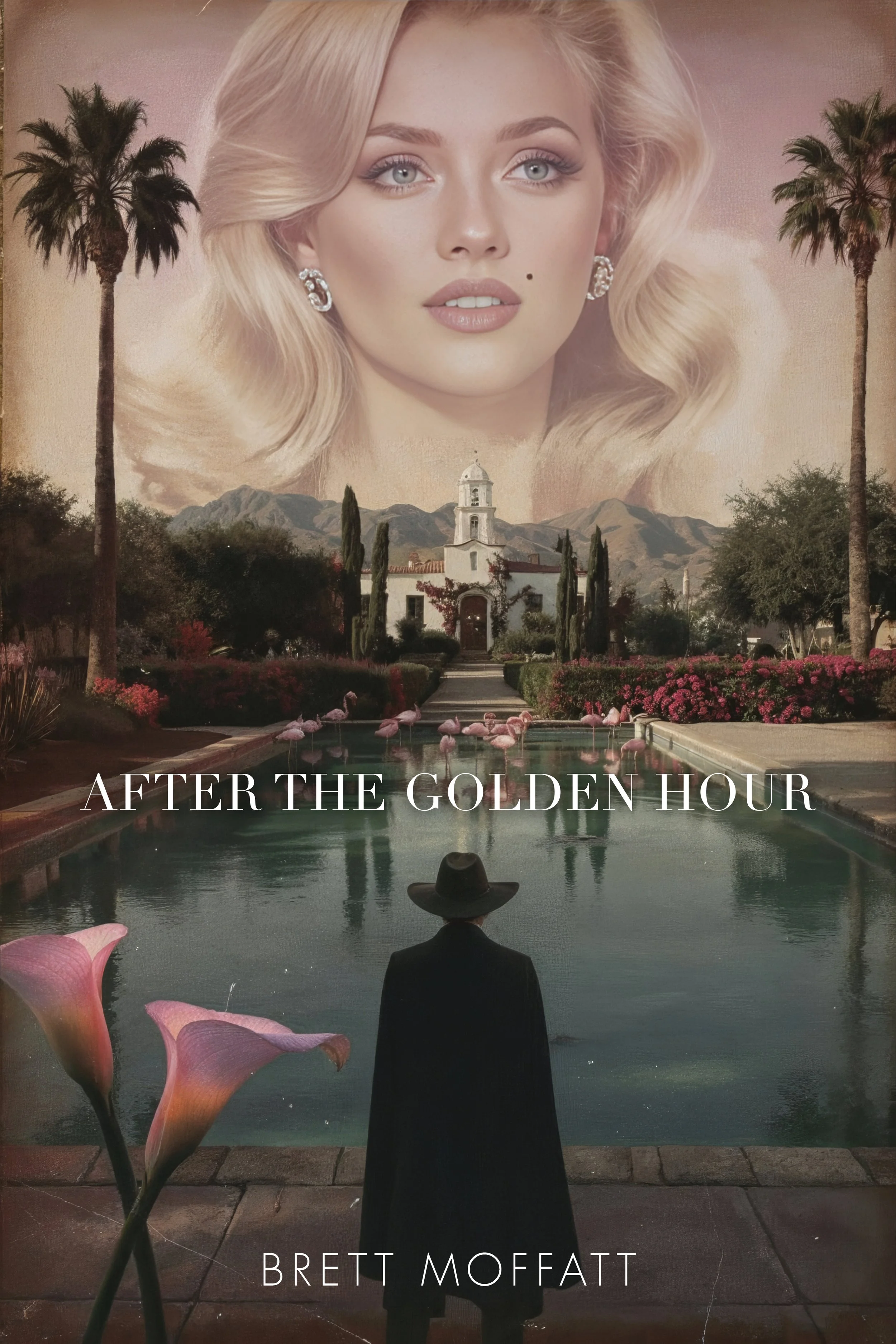
COMPANION OBJECT
The Novel
The novel follows one woman through the world of the golden hour; the exhibition paints the world itself.
After The Golden Hour · a novel · Evelyn St Clair, 1929–2024
Seventy-five years
In October 2024 Evelyn St Clair is ninety-five years old and has ordered a car. She does not tell the driver where they are going—partly because she is not certain, and partly because some places do not answer when you name them out loud. The novel is what she says on that drive: one morning, east out of Bel Air into the desert, with a scallop shell in her coat pocket that she has carried for seventy-one years.
What she wants to tell you begins in the summer of 1949, when she was twenty and three days west of her father’s ranch, and her Ford died somewhere past the place where the map ran out of names. The building she walked towards was a Spanish mission that had not been there a moment before. A foundation stone sat half-buried in the bougainvillea, carved with Latin she could not yet read: across this threshold, death and life pass. She did not become Evelyn St Clair in Hollywood. She became her that night, in the desert, at the Hotel California.
Everything after is the long cost of that crossing. There is a love in it that does not survive the decade, and a version of how it ended that she will carry, wrongly, for thirty-two years. It is not a memoir of Hollywood, though Hollywood is in it. It is a ghost story in the oldest sense: about love that changes form rather than ending, about who has been standing watch on the other side of the door, and about what it costs to arrive at a threshold empty-handed.
Published late 2027, alongside the exhibition
TWO EXCERPTS
“I cannot give you what you seek. I can only show you the door. What you see beyond it depends on what you’re willing to release.”
ONE · PART ONE, PROLOGUE: THE DREAM
I sat before a fire in the high desert, somewhere between sleep and waking, between Texas and whatever lay beyond it. The flames carved shadows from the darkness, and across from me sat an old woman who looked as though she’d been grown from the earth itself.
“You seek answers,” she said, her voice barely louder than the fire’s whisper. “You seek your truth, your destiny.”
The words weren’t a question. I said nothing, only watched as moths materialised from the darkness, dozens of them, drawn to the flames. Some hovered at the edge of the light, wings trembling with the heat. Others flew directly into the fire — whether willingly or by accident, I couldn’t tell — and disappeared in brief flares of combustion.
TWO · PART TWO: THE SITTING, SUMMER 1953
The heat in Burbank that July had a thick, honeyed weight to it, a stillness that pressed against the soundstage walls and turned the dressing rooms into small glass houses. Evelyn sat at her vanity in a silk robe the colour of crushed violets, her hair pin-curled into submission, while Gloria worked a sable brush across the rise of her cheekbone.
Cole leaned in. He looked at the photographs longer than courtesy required.
“Good God, Evelyn.” It was the first time he had said her name without the Miss. “What on earth are you doing, acting? You should be painting.”
She laughed — bright, startled, pleased in spite of herself.
“I am painting. I’ll retire to it one day. When acting is done with me, and I’m done with it, I’m going to live on the beach and paint every morning. The ocean, the dogs, the easel, the light. Paradise.”